LEARNING CENTER
Why Do We Get Goosebumps?
Discover why our skin gets goosebumps when we're cold, startled, or deeply moved—and what this tiny bodily reaction reveals about our mammalian past.
Why Do We Get Goosebumps?
Have you ever felt a chill run down your spine while listening to beautiful music? Have you stepped outside on a cold morning and watched tiny bumps appear all over your arms? Or perhaps a frightening moment made the hair on the back of your neck stand up.
Those little bumps have a name: goosebumps.
They are one of those everyday things our bodies do that we rarely stop to think about. But why do they happen? What purpose do they serve? And why can something as simple as a song or a powerful memory make our skin react as though we were standing in a snowstorm?
The answers take us on a fascinating journey through our skin, our brains, and our evolutionary past.
The Tiny Muscles Beneath Your Skin
Every hair on your body grows from a tiny pocket in your skin called a hair follicle. Attached to many of these follicles is a very small muscle called the arrector pili.
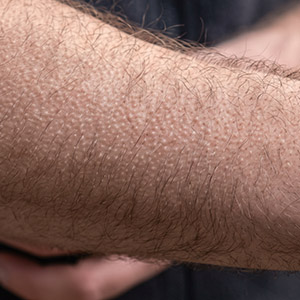
When this muscle contracts, it pulls the hair upright. The skin around the follicle rises into a little bump, creating what we call a goosebump.
You don't have to think about making this happen. Your body does it automatically, through a part of your nervous system that controls many functions you don't consciously direct, such as sweating and changes in heart rate.
The response can happen in a matter of moments. One minute your skin looks ordinary; the next, those familiar little bumps have appeared.
Why Would Our Ancestors Need Goosebumps?
To understand goosebumps, imagine an animal with a thick coat of fur.
When a furry animal gets cold, the tiny muscles attached to its hair follicles can make its fur stand up. The raised fur traps a layer of air close to the body, helping to retain warmth. It is a little like putting on an extra insulating layer without having to find a coat.
The same response can make an animal look larger when it feels threatened. Think of a cat arching its back and puffing up its fur when startled. The animal's appearance changes dramatically, making it seem more imposing to a potential opponent.
Our distant mammalian ancestors had body hair that could respond in similar ways.
Humans, however, have much less body hair than many other mammals. When our tiny muscles contract, we usually get the bumps without much of the insulating benefit. We have retained an old biological response, even though it no longer serves us as effectively as it does a furry animal.
In other words, goosebumps are a small reminder of our evolutionary history.
Why Do Emotions Give Us Goosebumps?
Cold isn't the only thing that can make your skin rise.
A moving piece of music, a dramatic moment in a film, a powerful memory, or a sudden feeling of awe can produce the same reaction. Some people experience goosebumps when they hear an especially beautiful voice or witness something extraordinary in nature.
Why?
Your brain doesn't simply respond to the outside temperature. It also coordinates your body's responses to emotions, excitement, surprise, and perceived danger. Through the autonomic nervous system, certain emotional experiences can activate the same tiny muscles that produce cold-related goosebumps.
Scientists sometimes use the term frisson for the sudden shiver or wave of chills some people experience in response to music or other emotionally powerful experiences.
Not everyone experiences this sensation in the same way. One person might get goosebumps during a stirring piece of music, while another feels nothing unusual. Neither response is wrong. Human bodies and emotional experiences vary.
And although goosebumps can accompany strong emotions, they don't tell us exactly what someone is feeling. The same physical response can have different causes.
Can You Give Yourself Goosebumps?
Sometimes, yes.
You can deliberately imagine a chilly scene, remember a particularly moving moment, or listen to music that you know affects you. For some people, these thoughts and experiences are enough to bring on a physical response.
Other people can produce goosebumps voluntarily, without an obvious external trigger. Researchers have documented people who report being able to do this, although it isn't a common ability and its mechanisms are not yet fully understood.
You can also notice the opposite: you may expect a particular song or memory to give you chills, but nothing happens. The response isn't a switch you can reliably flip.
Our brains and bodies are connected in complicated ways, and goosebumps are one small example of that connection.
Goosebumps Are Not the Same as Being Cold
Goosebumps often appear when you're chilly, but their presence doesn't always mean your body temperature is low.
They can happen when you're frightened, excited, moved by music, or struck by something beautiful or surprising. Conversely, you can feel cold without developing visible goosebumps.
That's because the response is part of a broader system that reacts to both physical conditions and emotional signals.
If you're cold, goosebumps are only one part of your body's response. Other processes, including shivering and changes in blood flow near the skin, play important roles in regulating body temperature.
So the next time your skin breaks out in bumps, remember that the cause may be more interesting than the weather.
A Little Mystery on Your Own Skin
Here's something to think about: why did evolution leave us with a response that is so useful to furry animals but often seems almost pointless on a mostly hairless human arm?
Evolution doesn't plan ahead or remove every feature that becomes less useful. Bodies inherit structures and responses from earlier generations, and those features can persist even when their original advantages become less important.
Goosebumps are a small example of that history. They are an ordinary part of being human, yet they connect us to other mammals and offer a glimpse of the ancient biological machinery still working beneath our skin.
The next time a chilly breeze raises the hairs on your arms—or a beautiful song sends a shiver down your spine—you'll know that your body is doing something far older than you might have imagined.
Sometimes the most fascinating science isn't hidden in a laboratory or a distant galaxy. Sometimes it's right there on your own skin.
Keep Exploring
Categories: