LEARNING CENTER
Why Do Humans Make Art?
What drove early humans to express themselves with art?
Why Do Humans Make Art?
Long before people had books, newspapers, cameras, or even written language, they were making art.
They painted animals on cave walls. They carved little figures from bone and stone. They decorated their bodies with pigments and jewelry. They made music, danced, told stories, and created objects simply because they were beautiful.
But why?
Nobody had to paint a bison on a cave wall. Nobody needed to spend hours carving a tiny figure out of bone. And if survival was the only goal, there were probably more useful things to do.
So why have humans been making art for thousands upon thousands of years?
The honest answer is: we don't completely know.
And that's what makes the question so interesting.
Art May Be Older Than Writing
Written language is relatively recent in human history. Some of the earliest known writing dates back roughly 5,000 years.
Humans were making art long before that.
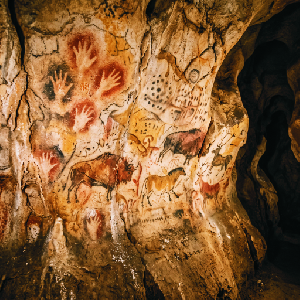
Some prehistoric cave paintings are tens of thousands of years old. They show animals, handprints, symbols, and scenes that may have had meanings we can only guess at today.
Imagine being one of those people.
You have no paper, no pencil, no camera, and no way to send a message to someone who isn't standing beside you. You take a piece of charcoal or a lump of colored earth and leave an image on a wall.
Why?
Maybe you were recording something important.
Maybe you were telling a story.
Maybe the image had a spiritual meaning.
Maybe you were teaching someone.
Or perhaps you simply saw a beautiful animal and wanted to make a picture of it.
We can't know for certain.
Art Can Tell Us Who We Are
One thing humans seem to do almost everywhere is decorate themselves and their belongings.
People have used beads, feathers, paint, tattoos, jewelry, clothing, hairstyles, and countless other things to communicate something about themselves.
Sometimes it's about belonging.
Sometimes it's about status.
Sometimes it's about beauty.
Sometimes it's simply, “This is me.”
Think about how much information can be communicated by someone's clothing today. You might learn something about a person's job, interests, culture, favorite music, personality, or even what they want other people to think about them.
Humans have apparently been doing some version of this for a very long time.
We Make Art When We Have Nothing Practical to Do
Here's something especially interesting:
Children make art.
Give a young child a piece of paper and something that makes a mark, and most children don't need to be taught that they can draw on the paper.
They experiment.
They scribble.
They make faces and houses and animals.
They draw things that exist—and things that don't.
They make up stories to go with their pictures.
And they often do this long before anyone tells them that they are supposed to be “creative.”
That suggests that making things may be a very natural human behavior.
We don't just want to use things.
We want to make things.
Art Helps Us Remember
Think about a photograph of someone you love.
The photograph isn't the person. But it can bring the person immediately to mind.
A song can do the same thing.
You can hear a few notes from a song you haven't heard in thirty years and suddenly find yourself standing in a particular place, remembering a particular person or a particular summer.
Art can act like a kind of memory machine.
Paintings, photographs, music, stories, sculptures, quilts, jewelry, buildings—even recipes—can carry pieces of people's lives forward.
Sometimes we don't just make art for ourselves.
We make it so that someone else can remember us.
Art Helps Us Say Things We Can't Explain
There are feelings that are difficult to put into ordinary words.
A person might not be able to explain exactly what grief feels like.
But they might write a song about it.
Someone might not know how to describe the feeling of falling in love.
They might paint it.
A dancer can express something without saying a single word.
A storyteller can take a feeling that seems impossible to explain and give it characters, places, and a beginning and an end.
Art gives us another language.
Sometimes it's a language that crosses cultures and centuries.
We may not know what an ancient artist was thinking when they painted a particular animal on a cave wall.
But we can still look at it and recognize something familiar:
A human being saw something that mattered to them and wanted to make a record of it.
Maybe We Make Art Because We're Human
There are plenty of practical things humans have invented because they make survival easier.
We invented better shelters.
Better tools.
Better ways to store food.
But somewhere along the way—or perhaps right from the beginning—we also made things that weren't strictly necessary.
We painted.
We sang.
We danced.
We told stories.
We carved.
We decorated.
We imagined.
And then we taught our children how to do those things too.
Perhaps there isn't one answer to the question “Why do humans make art?”
Maybe we make it to communicate.
To remember.
To belong.
To understand ourselves.
To entertain ourselves.
To make sense of the world.
To express feelings.
To leave something behind.
Or maybe, sometimes, we make art for the simplest reason of all:
Because we saw something beautiful, interesting, funny, frightening, or wonderful—and we wanted to make something of our own.
Whatever the reason, one thing seems remarkably clear.
Humans don't merely survive in the world.
We have an almost irresistible urge to leave a little bit of ourselves in it.
Keep Exploring
Categories: